

Cyberpunk 2077 DLSS + Ray Tracing Benchmark
Today we'll exist doing a follow up on our initial Cyberpunk 2077 benchmark coverage with a look at how the game performs with ray tracing. Does that mean we get to meet how the latest GeForce RTX 30 series compares against AMD's Radeon RX 6800 XT that come up with DXR hardware support...? Not then fast.
Cyberpunk 2077 will be updated with support for AMD GPUs at some signal in the futurity, but for now you lot will demand an Nvidia RTX GPU for running ray tracing, and today we'll be looking at performance across all master consumer RTX GPUs in a variety of ray traced settings.

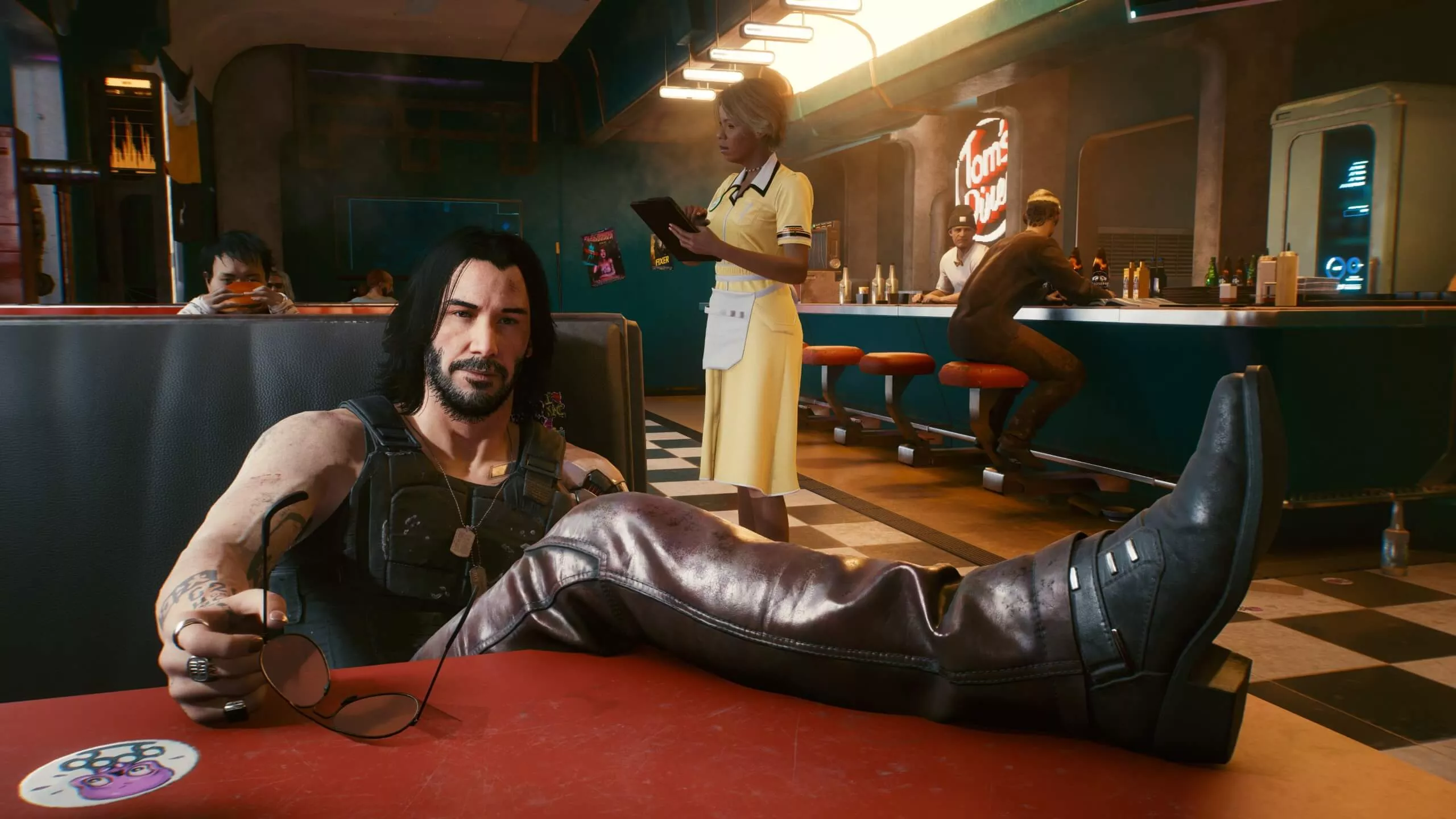
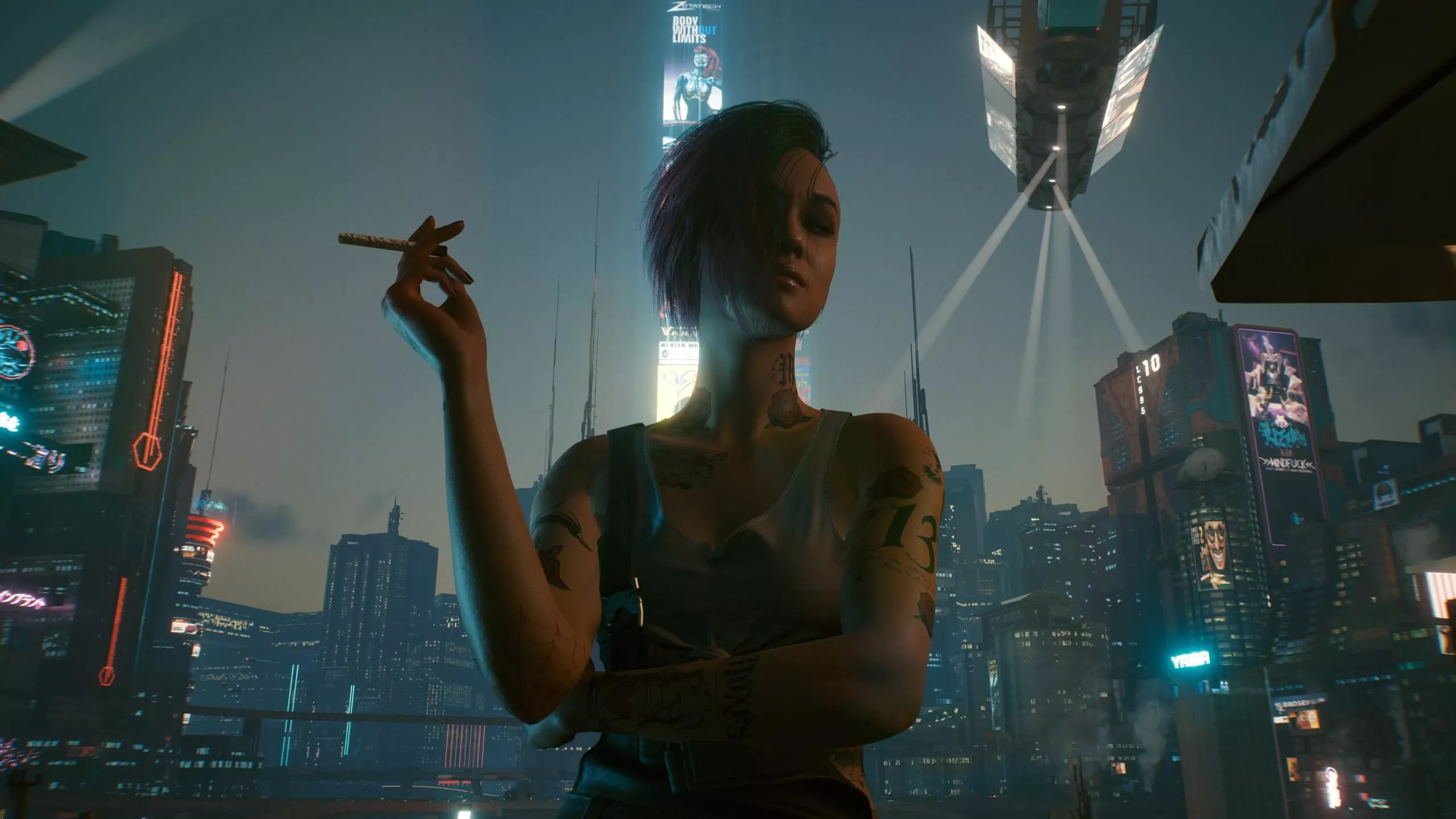
By at present, most of you are likely aware how visually stunning Cyberpunk 2077 is. This is certainly one, if not the near graphically impressive game we've ever seen, and information technology does look peculiarly good with ray tracing enabled. That's non to say the game looks bad without ray tracing, it yet looks incredible, just ray tracing elevates the game's visuals and provides a noticeable improvement.
Cyberpunk has ray tracing support split up into iii settings: ray traced reflections, ray traced shadows, and ray traced lighting, the latter of which has three unlike modes.
Reflections is arguably the biggest setting in the game, providing the most substantial visual upgrade over standard rasterization. What'south most impressive about the mode Cyberpunk handles ray traced reflections is how many surfaces reflections get practical to. It'south not but the regular glass and puddles of water, merely a whole range of surfaces that include more matte elements and metals. While many of these surfaces still receive screen space reflections to some extent and look good without ray tracing, turning on ray traced reflections delivers a adjacent level experience that enhances the overall visual quality.
The way reflections are handled on glass is particularly impressive, however there are some limitations, like the lack of reflections for your actor character, which is a tad baroque but obviously was too performance intensive to include. Other times, you volition see noticeable pop in with reflections as lighting or geometry is added or subtracted every bit you move the photographic camera around, a common effect we run across from ray tracing in today's games. Only of class, there are a wealth of issues with screen space reflections, too, so compromises are ever a office of today'southward graphics.

Ray traced shadows are applied from either the sunday or moon as a light source only, and compared to running ultra rasterized shadows, there's a subtle difference depending on the part of the globe. Against a desert properties for example, the ray traced shadows add together a more realistic feel.
The ray traced lighting setting combines ambient occlusion, lengthened illumination and, if you utilise the psycho setting, global illumination. This is more noticeable than ray traced shadows, but notwithstanding on the more than subtle end of the scale, peculiarly when outdoors during the mean solar day. With ray traced lighting off, some areas have an unnatural glow, and at other times this setting tin actually add lighting back into the scene. The differences between medium and ultra lighting are the most subtle, and for most people looking to run ray tracing but save on functioning will be fine with the medium setting hither.


Multiple image credit: DTF.ru
On the DLSS front (spoiler: you lot have to/desire to use DLSS in this game), nosotros have a range of settings in the game from Quality through to Ultra Functioning. Each of these settings reduces the game's return resolution, then uses reconstruction to bring it dorsum up to your target resolution. At 4K, Quality renders at 1440p, Functioning at 1080p, Balanced in-between those 2, and Ultra Performance way downward at 720p. You'll meet similar ratios at other target resolutions.
DLSS Quality is most similar to native resolution at all target resolutions, and is the setting we recommend people use in most situations. To break this downwards but, the Quality manner isn't quite as good every bit native rendering for close up particular, but does a good job at matching or even beating native rendering for more afar fine detail. On a few occasions, DLSS was able to bring dorsum lost detail at native rendering, just at other times the paradigm wasn't equally strong.

Other DLSS settings beneath 'Quality' you lot will detect visuals are not equivalent to native rendering. Particularly at 1440p, DLSS Performance is quite blurry in comparison, and as this applies to the entire image, to my eyes it doesn't look great and we'd avoid using it. We should note that the differences nosotros depict probably won't bear witness up clearly on YouTube videos. We've also seen numerous reports of rendering glitches and artifacts using DLSS in this game, which is something to be aware of and volition hopefully get patched out over time along with the game'south many other bugs.
Image Quality Comparison
Click on the images to see a total resolution version in our image gallery. Go dorsum/forwards to see changes.


Benchmarks
Throughout the performance section of this article, our goal will exist to look at Nvidia's unabridged RTX line-up, and see what sort of GPU you will need for playing with diverse dissimilar ray tracing settings at various different resolutions. All tests in this performance review were run on a Core i9-10900K examination rig with 16GB of dual-aqueduct DDR4 retention, using the latest GeForce drivers. Our benchmark pass is the same every bit before, which is at night in the rain with a broad diverseness of furnishings present.
1440p Performance
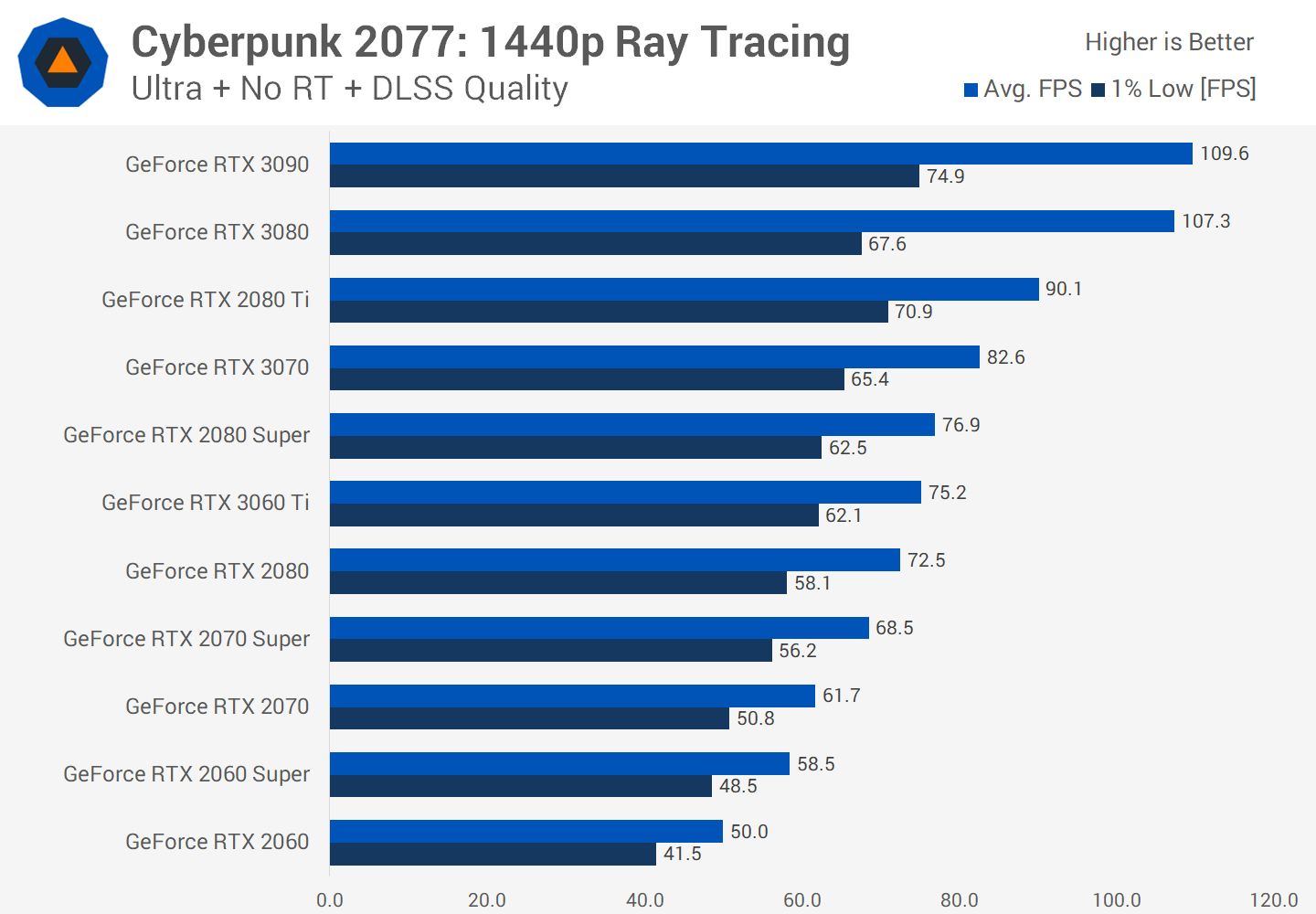
We'll start with 1440p gaming. These are our baseline results with the Ultra preset and DLSS Quality enabled, but no ray tracing. In this configuration, all of the RTX line-up delivers a playable feel, although the RTX 2060 is closer to a fifty FPS feel.
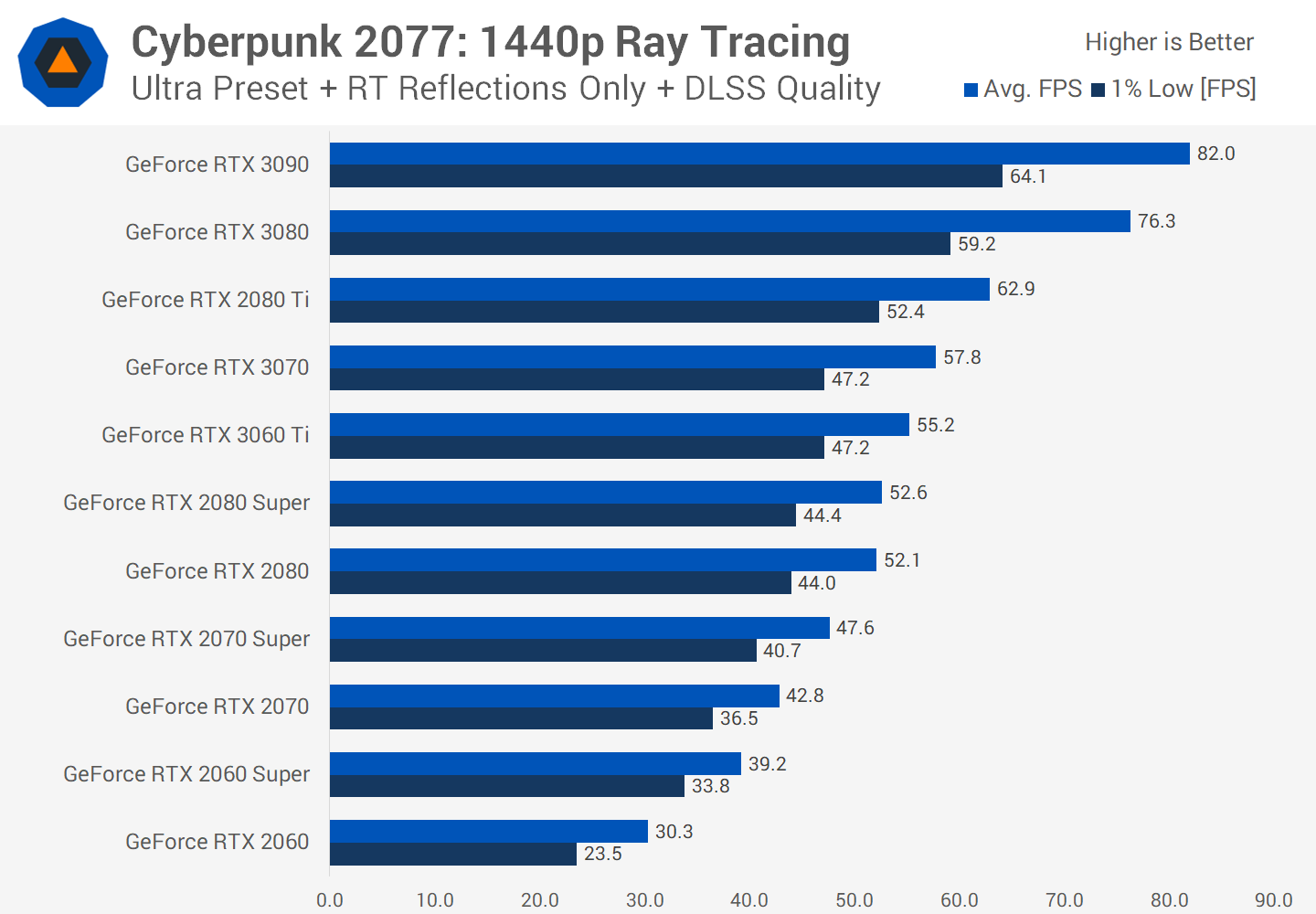
Here are the results using what we're calling "minimum" ray tracing, which is having but reflections enabled. In our opinion, if y'all desire to dip your toes into ray tracing, the best mode to do that is with reflections as information technology has a noticeable visual improvement, and surprisingly, isn't as performance intensive as other settings. From here yous tin can add effects to amend visuals which we'll talk about in a moment.
If y'all desire a 60 FPS experience using ray tracing at this resolution, you lot'll need to have at to the lowest degree an RTX 2080 Ti in your setup to achieve that level of performance. The RTX 3080 and 3090 are strong performers, merely the RTX 3070 isn't as much. That's because if you are using the Ultra preset, with ray tracing, 8GB of VRAM is correct on the edge in this title and actually does limit functioning to some extent.
Having the 11GB VRAM buffer of the 2080 Ti is superior for ray tracing in this game, despite both the 3070 and 2080 Ti delivering about the same performance without RT enabled.

Below that, GPUs like the RTX 3060 Ti and RTX 2080, are non hitting 60 FPS on average, so you'll need to compromise in some way. That might be in terms of performance – you may be fine putting upwards with below 60 FPS – or alternatively you tin can drib visuals. This could be dropping the overall preset to High or Medium, or reducing DLSS quality. But either manner, ray tracing on cards beneath 2080 Ti levels of performance at 1440p is going to exist compromised in some mode.

If you run the medium ray tracing preset, which swaps out ray traced reflections for shadows and medium lighting, performance is slightly worse in our benchmark pass than just using reflections. We don't feel this preset is the best demonstration of ray tracing in the game, and like nosotros said y'all should probably showtime with reflections and so add lighting, not the other fashion around.
If you want to run reflections and medium lighting at the same time, the requirements in terms of GPU horsepower increase. At this point, the RTX 2080 Ti is no longer a 60 FPS GPU, although the RTX 3080 and 3090 are still very playable with an average over 60 FPS. Cards in the lower RTX range like the RTX 2070 are now delivering a console-similar thirty FPS experience
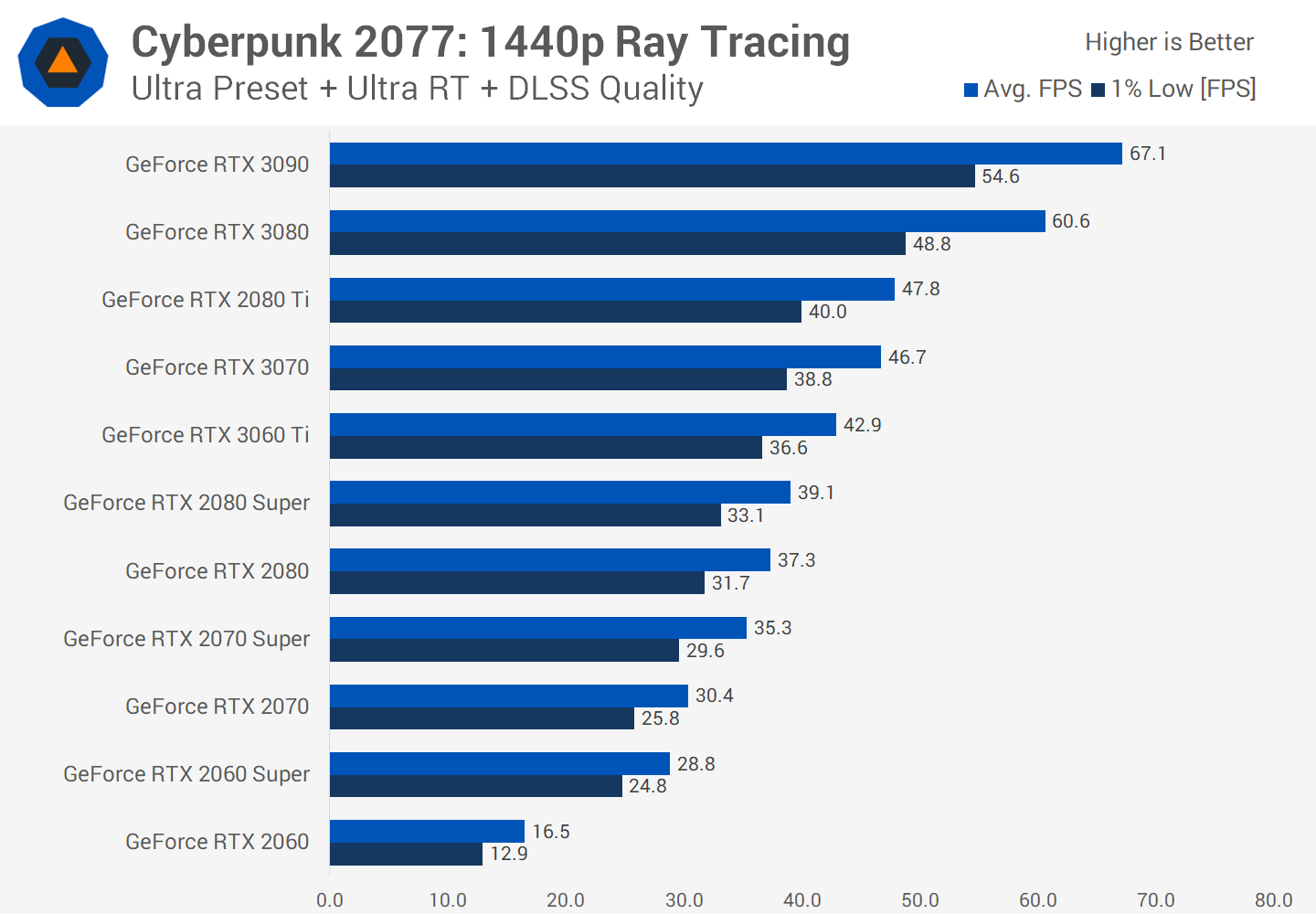
For Ultra ray tracing you'll definitely need either an RTX 3080 or 3090 for 1440p gaming at 60 FPS. Other GPUs can't go on up here and even the 3080 is teetering on the border of acceptable performance. While we didn't do extensive testing of the Psycho fashion, expect that to require an RTX 3090.
With the RTX 3080, enabling "minimum" ray tracing with just reflections will reduce performance past 29% at 1440p, as opposed to 33% when using the medium RT preset. If you want both reflections and medium lighting, expect to shave off a further 12% from the reflection just numbers, while Ultra ray tracing takes its toll with a 44% reduction compared to no ray tracing at all.
On the RTX 2080 Ti, the numbers are much the aforementioned although the performance drop is slightly college on this GPU, with at least a 30% reduction and up to a 47% drop with ultra ray tracing. And so y'all'll need to have proficient baseline operation to turn on ray tracing in this game.
Testing at 4K
Going up in resolution to 4K, it's non great news. Fifty-fifty with simply ray traced reflections enabled, the RTX 3090 does not deliver a 60 FPS experience with DLSS Quality, while the RTX 3070 is already sitting beneath 60 FPS and quite constrained past just 8GB of VRAM. 4K with ray tracing in this title is really a future-looking mode, this is something to revisit in future generations when nosotros have more than powerful ray tracing GPUs.
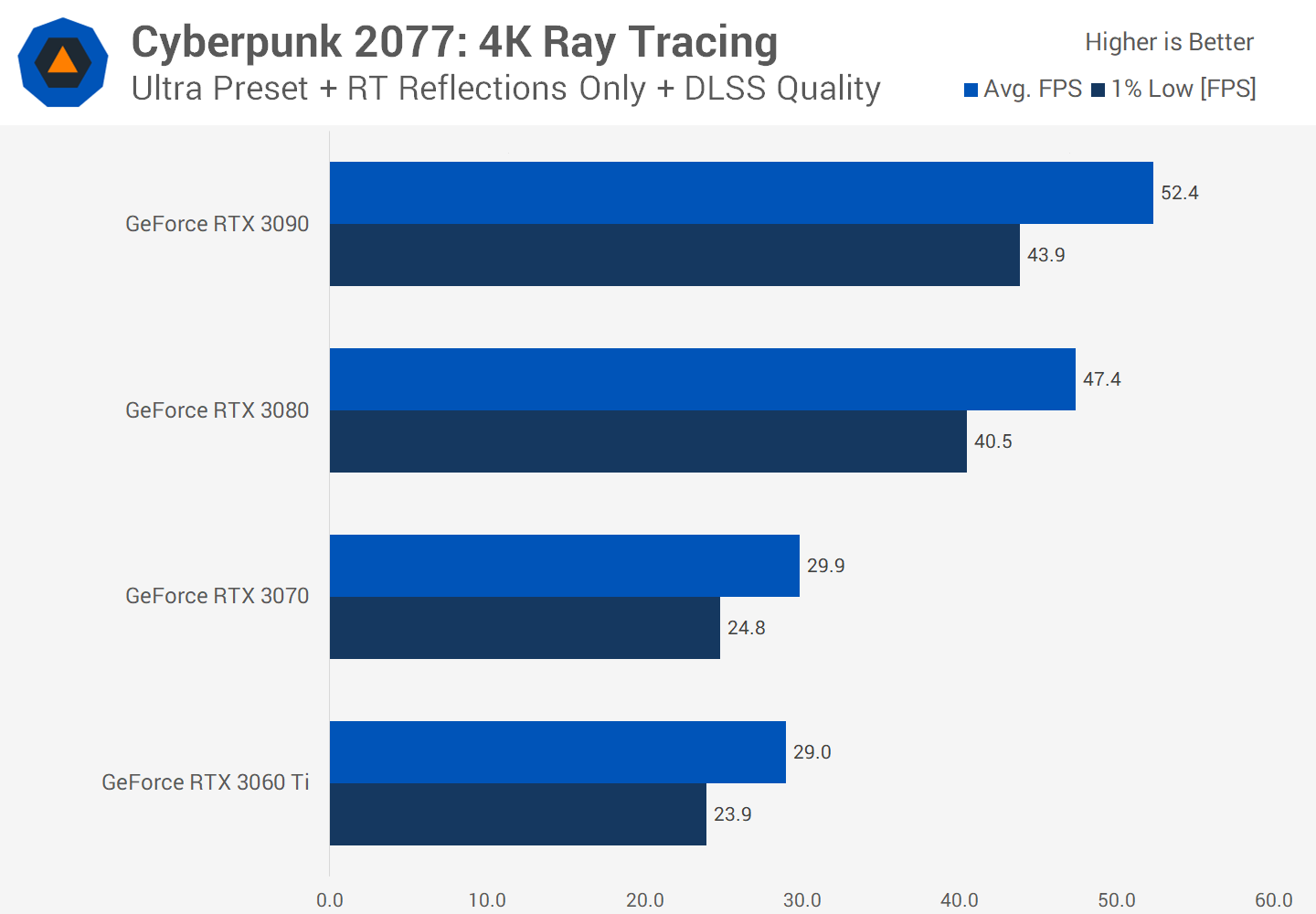
Correct now if you practise want to play at 4K with ray tracing, you will need to compromise on visual quality or just accept lower performance. Yous might want to experiment with lower DLSS settings, or reducing the regular visual preset.

Clearly, 4K ray tracing with the Ultra preset is a seriously functioning intensive mode with not even the pinnacle of the line RTX 3090 delivering a 40 FPS experience. Even with a variable refresh charge per unit display, this is a sluggish experience and honestly yous should turn down the settings to become lx FPS. Like we said before, this is really meant for future GPUs with improved levels of performance.
Down to 1080p
In that location'southward improve news at 1080p. With simply ray traced reflections, the Ultra preset, and DLSS Quality, the game is accessible to nigh RTX GPU owners at an acceptable level of functioning. The RTX 2060 Super and RTX 2070 are correct on the edge hither with a sub-sixty FPS boilerplate, but provided you have a 2070 Super or college, 1080p gaming in this title is decent.
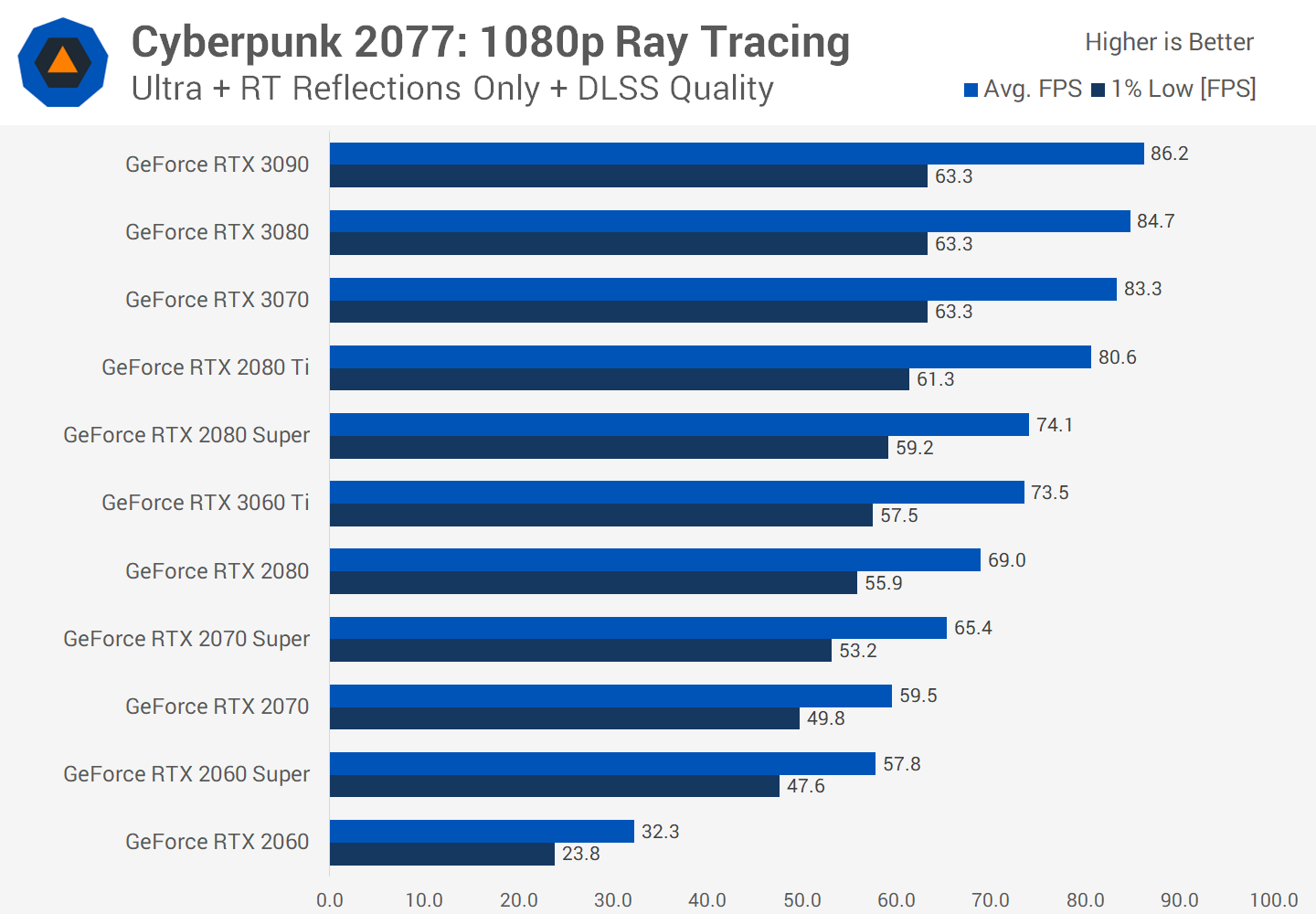
Owners of the original RTX 2060 are compromised here though. Nosotros did mention this in our 2060 review way back when it was released, but nosotros're seeing the reality of the situation at present: this GPU is insufficient for ray tracing in modernistic titles. The principal limitation here is VRAM, but 6GB of VRAM is not enough for ultra settings plus ray tracing. This volition go on to happen with other offset-gen RTX GPUs as games become more intensive and use more ray tracing effects: the 2060 Super and 2070 are next in line.
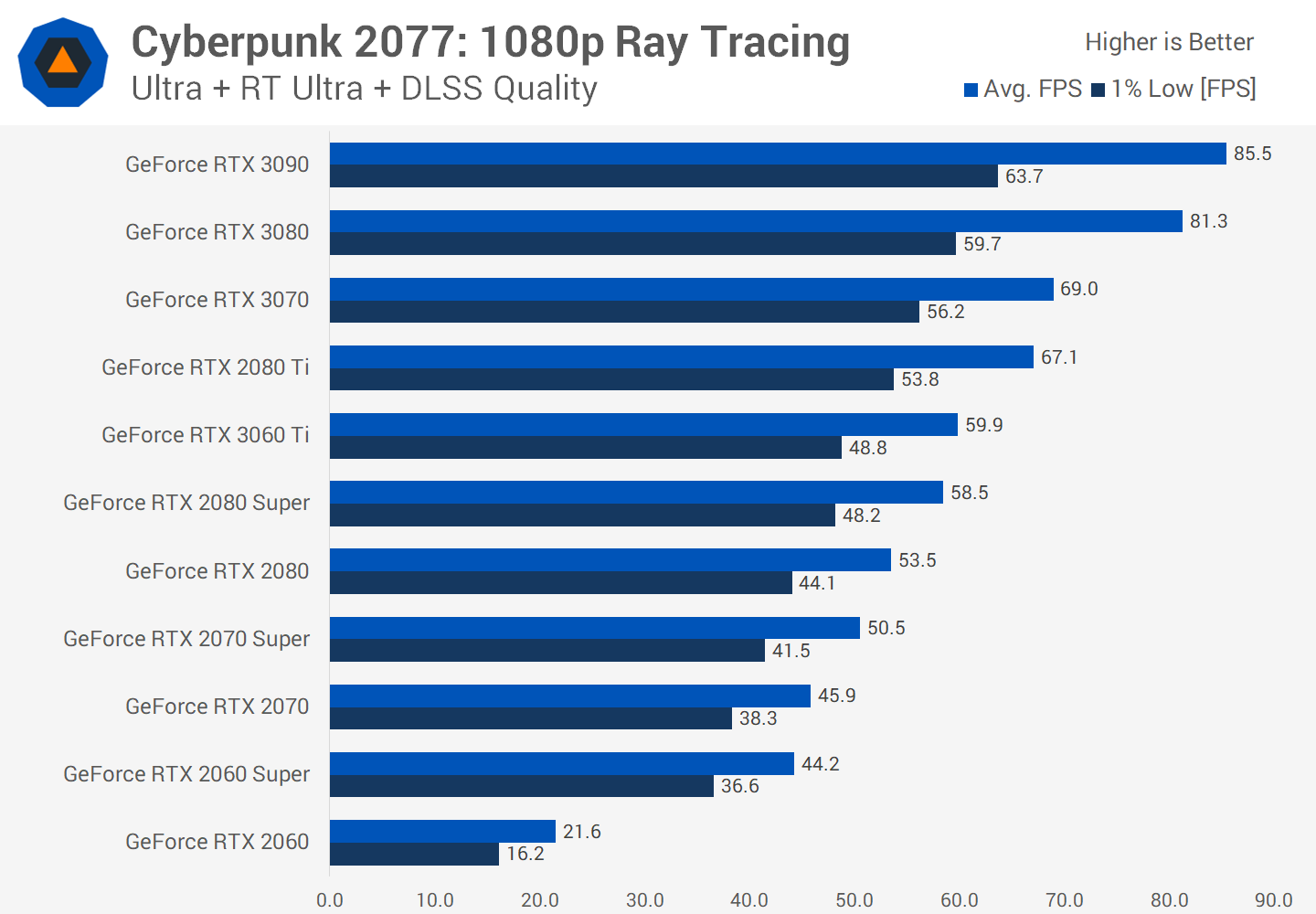
Speaking of the RTX 2070, this GPU is non sufficient for ultra level ray tracing at 1080p. For that, y'all'll need an RTX 3060 Ti or meliorate, with the RTX 2080 Super providing a borderline feel. If there's annihilation that tells you just how performance intensive ray tracing is in this title -- or alternatively how lacking showtime-gen RTX GPUs were for RT performance -- it's that a $700 GPU from simply a few years ago isn't capable of ultra ray tracing in this title at fifty-fifty 1080p with DLSS enabled. Luckily for buyers today (if you lot tin can find the cards in stock), the RTX 3060 Ti isn't too bad in this title at this resolution.
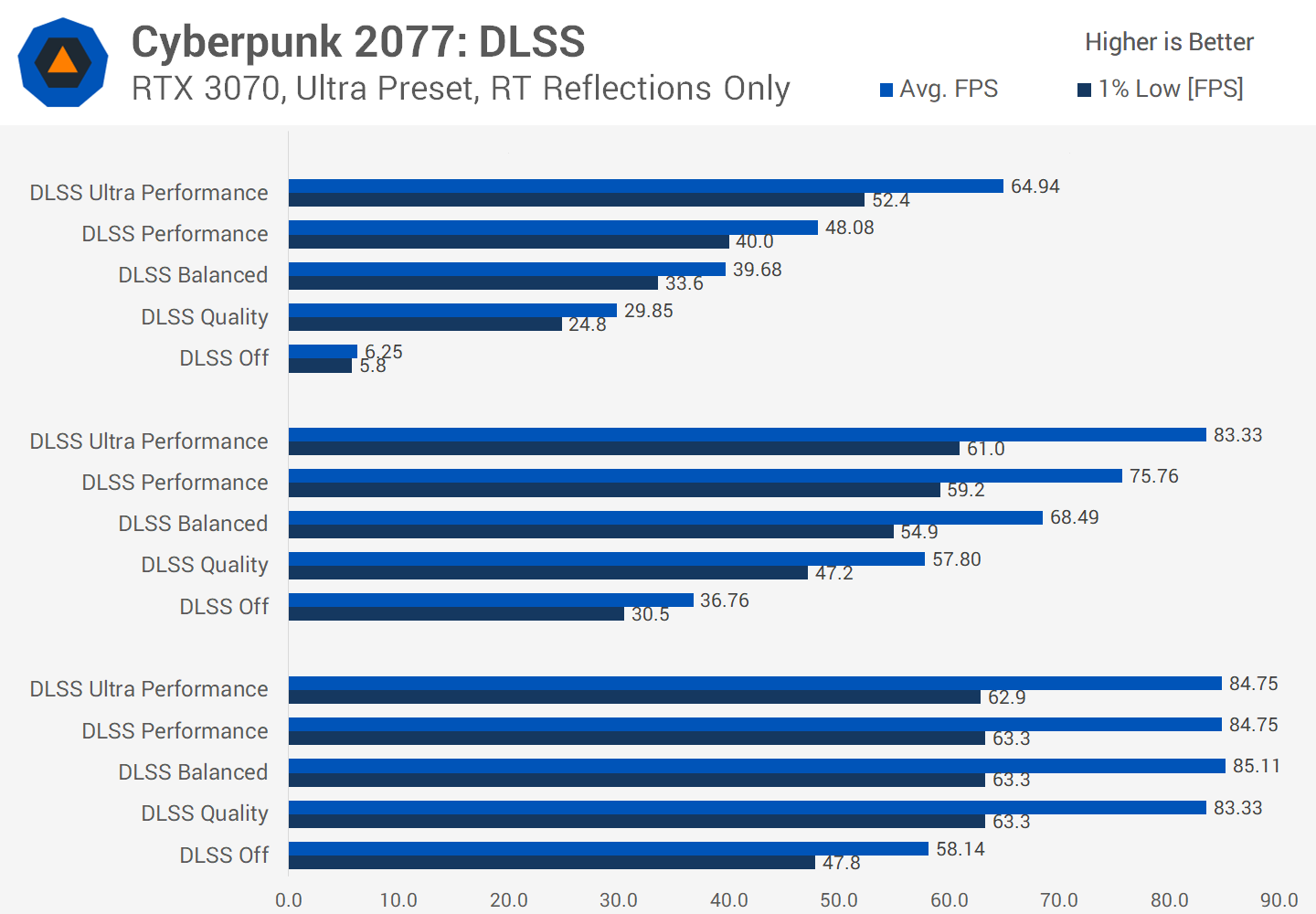
Now here's a brief look at DLSS performance in Cyberpunk 2077, with the RTX 3070 and ray traced reflections at 1440p. DLSS is key to performance with ray tracing enabled as yous tin can see that at 1440p with DLSS disabled, the RTX 3070 is only a 30 FPS GPU. Turning DLSS on to the Quality manner improves operation to 58 FPS, and with the Performance fashion information technology goes upwards to 76 FPS, although we wouldn't recommend it at this resolution due to the loss in visuals.
At 4K yous might need to reject the DLSS settings to Performance with this GPU to get adequate frame rates, but you lot tin can see that the performance improvement is very significant over DLSS disabled. In fact, the game is a slideshow without DLSS enabled and hits a heavy VRAM limitation, but at least with DLSS rendering the game at lower resolutions, it is able to exceed 30 FPS which is a substantial functioning comeback.
DLSS FTW!
From a visual standpoint, we think Cyberpunk 2077 is the best showcase we've had so far of what ray tracing can bring to the table. The game looks fantabulous with it enabled. The reflections setting noticeably improves graphics quality in our opinion, with more realistic lighting also possible through the other settings.
This is non a Shadow of the Tomb Raider where often the differences are negligible, ray tracing in this game is a potent visual upgrade on the regular rasterization settings. It's besides a title that makes sense to take ray tracing in, as part of this game's fundamental focus is offering next-gen visuals and it'south non a fast paced competitive shooter similar Fortnite where ray tracing is nearly pointless (or at least information technology is when you lose so much performance).

The game's visuals are also stunning without ray tracing enabled, so those on less powerful mid-range GPUs can notwithstanding savour a breathtaking experience. We wait a sizable portion of gamers will be playing with RT disabled as they simply don't accept the GPU ability required, all the same you can nonetheless enjoy the gameplay and experience overall.
The small-scale handful of Radeon RX 6000 owners out at that place should feel a fiddling fleck annoyed that Cyberpunk doesn't even permit y'all to enable ray tracing on AMD GPUs. DXR is meant to be a vendor-agnostic open platform, even if performance is terrible, at least allowing AMD owners to try information technology out would take been overnice.
Speaking of performance, Cyberpunk 2077 equally we know is quite punishing on GPUs. If you lot want an uncompromised ray tracing experience (with DLSS) at 1440p, you lot'll demand at least an RTX 2080 Ti for a decent experience, or an RTX 3080 for ultra level ray tracing. 4K is pretty much out of the question right now if you want a solid 60+ FPS experience, while at 1080p down to virtually an RTX 2070 or 2070 Super is where you can get in on ray tracing.
In all other scenarios, yous'll need to detect an adequate trade-off to enjoy ray tracing. Whether that'due south playing with lower DLSS quality, a lower resolution, or lower graphics settings. This will be especially disappointing to those that bought an RTX 2080 or 2080 Super at launch for $700, these GPUs aren't powerful plenty for 1440p ray tracing unless y'all brand some compromises, and we don't remember too many people bought a $700 GPU for 1080p gaming.

It'south important to notation that VRAM is a big factor in Cyberpunk with ray tracing enabled. It's the primary reason why the RTX 2060 is so irksome, and it as well causes limitations for the RTX 3070 with 8GB of VRAM beingness right on the edge at ultra settings. The RTX 2080 Ti, despite delivering similar functioning without ray tracing enabled, is the faster GPU with RT enabled thanks to its 11GB VRAM buffer.
While not identical to native rendering, using the DLSS Quality manner in some areas can be better and others a tad worse. Overall though, DLSS 2.0 delivers a good experience and a much necessary heave. Operation is very good with DLSS enabled, and honestly Cyberpunk 2077 would be basically unplayable with ray tracing and native rendering without this resolution scaling + AI magic.
Shopping Shortcuts:
- Nvidia GeForce RTX 3090 on Amazon
- Nvidia GeForce RTX 3080 on Amazon
- Nvidia GeForce RTX 3070 on Amazon
- AMD Radeon RX 6800 on Amazon
- AMD Radeon RX 6800 XT on Amazon
- AMD Radeon RX 6900 XT on Amazon
- AMD Ryzen nine 5900X on Amazon
- AMD Ryzen 5 5600X on Amazon
Paradigm credit: DTF.ru for multiple screenshots showcasing ray tracing effects

Source: https://www.techspot.com/article/2165-cyberpunk-dlss-ray-tracing-performance/
Posted by: johnsoneimstand.blogspot.com
0 Response to "Cyberpunk 2077 DLSS + Ray Tracing Benchmark"
Post a Comment